

Seam types describe how pieces of fabric are arranged, joined and finished to create a garment. A plain seam keeps construction simple; a French seam encloses delicate raw edges; a flat-felled seam spreads load through folded layers; and an overlocked construction can join and neaten stretch fabric efficiently.
No seam is automatically the strongest, most comfortable or best value. The result depends on the complete system: fabric, thread, stitch formation, stitch density, seam allowance, machine setup and production quality. Choose the structure for the garment’s job, then prove it on the actual material.
Seam Type and Stitch Type Are Not the Same Thing
A seam is the physical arrangement of material at a join; a stitch is the thread formation that holds or finishes it. ISO 4916 classifies stitched seam structures, while ISO 4915 separately classifies stitch types (ISO 4916; ISO 4915).
“Plain seam” therefore names a construction, while lockstitch, chainstitch, zigzag and overlock name thread formations. The phrase seam stitch types is useful only for the selected combination: a woven shirt may use a lockstitched plain seam with separately overlocked allowances, while a knit T-shirt may be joined and neatened with an overedge stitch in one operation.
Common Seam Types at a Glance
| Seam type | Construction and visible features | Typical strength and bulk direction | Suitable fabrics or garments | Production consideration |
|---|---|---|---|---|
| Plain seam | Pieces are placed face to face and stitched near the edge; allowances remain inside | Low to medium bulk; strength depends heavily on stitch, thread and fabric | Shirts, dresses, trousers, linings and general woven garments | Fast and adaptable, but raw edges often need separate finishing |
| French seam | First seam is turned and enclosed by a second seam | Clean interior; can become bulky on thick cloth | Chiffon, voile, lightweight shirts, delicate or unlined garments | Two sewing passes, trimming and accurate pressing |
| Flat-felled seam | Allowances are folded into each other and secured flat, usually with visible parallel stitching | Robust, enclosed and relatively flat, but multiple layers add thickness | Jeans, workwear, casual shirts and durable woven garments | More handling and accuracy; difficult at tight curves or bulky intersections |
| Lapped seam | One piece overlaps another and stitching passes through the overlap | Strength and bulk vary with overlap and edge treatment | Leather, non-fraying materials, workwear details and some technical constructions | Alignment and overlap width must remain consistent |
| Bound seam | A separate strip wraps an exposed edge or seam allowance | Neat and protected, with extra local bulk from binding | Unlined jackets, necklines, armholes and premium interior finishes | Adds binding material, preparation and sewing operations |
| Overlocked or serged construction | Overedge stitches wrap and may trim the raw edges while joining or finishing | Low-to-moderate bulk with useful extensibility when correctly specified | T-shirts, underwear, knitwear and efficient casualwear production | Machine, thread count, differential feed and tension must suit the fabric |
| Welt seam | A plain seam is graded and pressed to one side; the larger allowance is topstitched to enclose the smaller | Flatter than a fully felled seam in many versions; one allowance remains part of the structure | Trousers, jackets, skirts and tailored or denim-style details | Requires trimming, pressing and controlled topstitching |
Treat the table as a shortlist, not a universal ranking. The same named seam can perform differently when its width, stitch, thread or material changes.
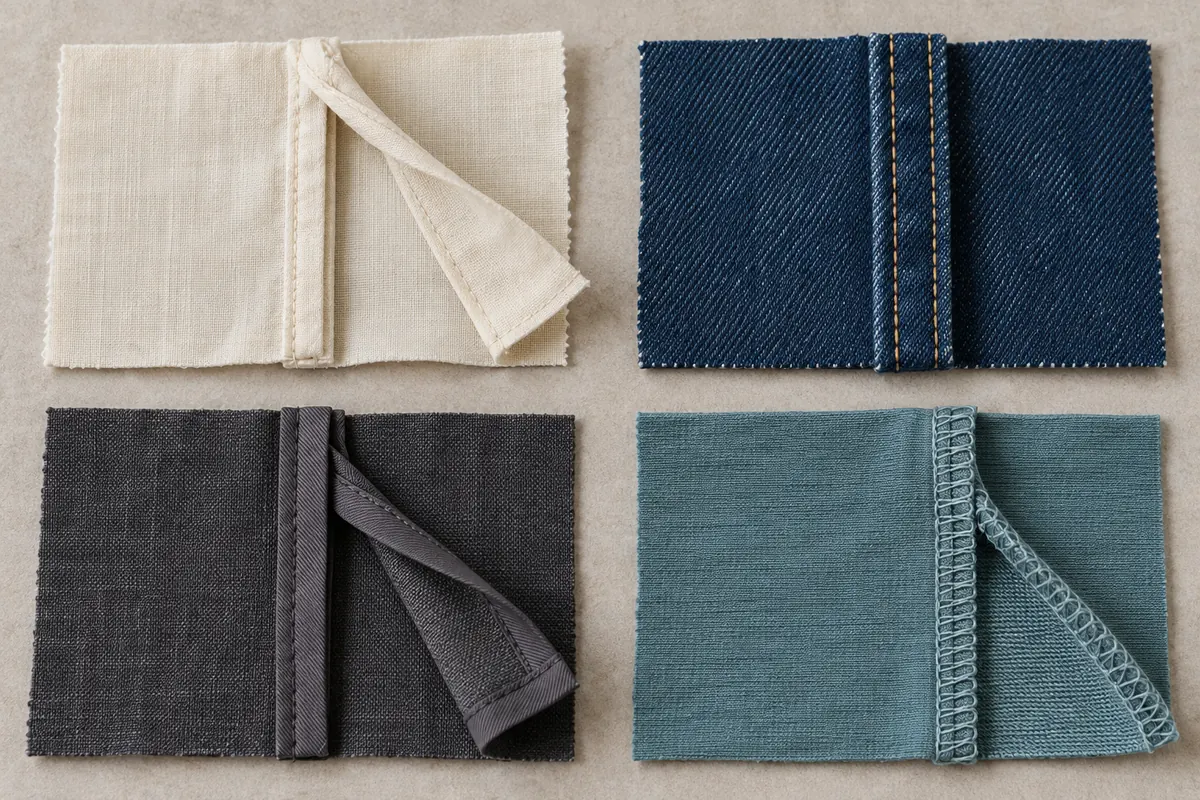
How the Main Garment Seams Differ
Plain seam: the flexible default
A plain seam begins with two pieces placed right sides together and one joining line. It is fast, adapts to curves and remains alteration-friendly. Allowances can be pressed open or to one side, then pinked, overlocked, bound or covered by a lining; fraying cloth needs an appropriate finish.
French seam: a clean solution for light fabric
A French seam hides both raw edges inside a narrow folded channel. The first line is sewn with the fabric oriented one way; the work is trimmed, turned and sewn again so the first allowance is captured.
This clean interior suits sheer or lightweight unlined garments. Tight curves and heavy cloth can make the layered channel hard to turn or bulky. The US National Institute of Standards and Technology glossary describes the defining feature as a second operation that encloses the seam edge (NIST apparel glossary).
Flat-felled seam: enclosed structure with visible character
In a true flat-felled seam, opposing folded allowances interlock beneath rows of stitching. It hides raw edges and lies flat, making the structure useful for jeans, workwear and shirts. Durability still depends on thread, stitch formation, folded width, fabric and workmanship; bulky intersections must be sampled.
Lapped seam: overlap rather than face-to-face joining
A lapped seam places one piece over another. Cut edges may remain visible on non-fraying materials or be folded and covered. Flat-felled seams belong to this broader family, but not every lap seam is flat-felled.
It can suit leather, felt-like materials, workwear panels and visible design lines. Accurate marking matters because an inconsistent lap changes both garment dimensions and topstitching.
Bound seam: raw-edge control as a design decision
A bound seam wraps a separate strip around an exposed edge or allowance. It can protect the edge and give an unlined jacket, neckline or armhole a deliberate finish.
Binding width, stretch, thickness and grain direction matter. A stiff strip may distort curves, while a bulky strip can create discomfort and extra handling cost.
Overlocked or serged seam: efficient joining and finishing
“Overlocked seam” is useful shop-floor shorthand, but technically the overlock is a stitch formation or edge-neatening method, while the underlying seam still has a material arrangement. An overedge machine can trim, join and wrap edges in one pass, which makes it efficient for many knitted garments.
Stretch is not automatic. Thread, stitch width, density, differential feed and tension must allow extension and recovery. Wavy edges, tunnelling or popped thread indicate a mismatch or poor setup—not that every overlocked seam is weak.
Welt seam: controlled topstitching with less enclosure
A welt seam starts from a plain seam, then grades the allowances and topstitches the larger one over the smaller. NIST defines it as a flat inside seam pressed to one side, with the larger allowance enclosing the smaller.
It can create a tailored line with less folded bulk than some flat-felled constructions. Because trade usage varies, a factory specification should include a cross-section or approved sample.
Choose a Seam Through Five Filters
This framework converts garment requirements into a short production decision.
- Start with movement and stress. Locate joins that must stretch, resist pulling or stay crisp; leggings and a lined jacket do different jobs.
- Read the fabric behaviour. Check fraying, thickness, stretch, recovery, slipperiness and pressing. The knit vs woven fabrics guide separates structure from fibre assumptions.
- Set the appearance. Decide whether allowances may show, must be enclosed or form part of the design.
- Control bulk and skin contact. Count layers at intersections and flag seams under straps, waistbands or close-fitting areas.
- Test production reality. Sew the actual fabric with the intended thread, needle, machine and allowance; inspect movement, puckering, skipped stitches and edge security after the intended care process.
The output is not one “best seam.” It is a location-by-location seam plan supported by a physical sample.
Seam Selection by Garment and Fabric
| Garment or material | Useful starting direction | Why it may fit | What to confirm |
|---|---|---|---|
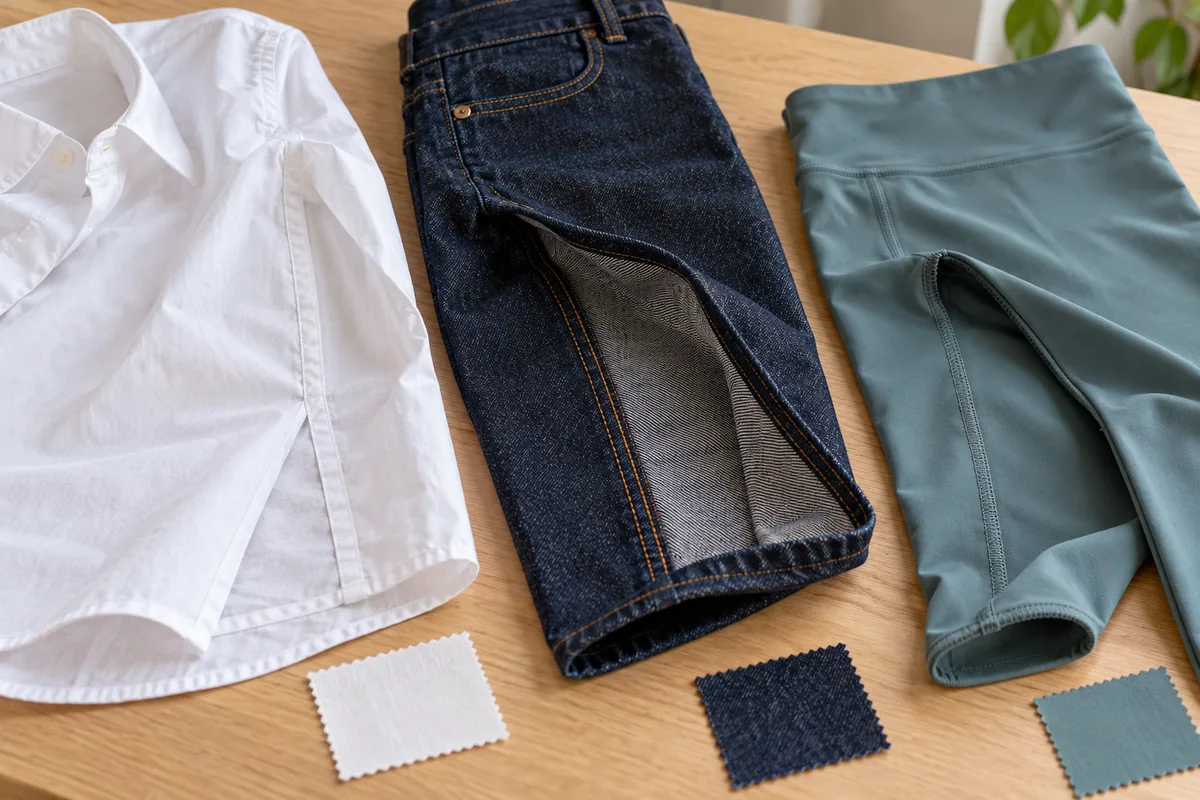
| Woven shirt | Plain with finished allowances, French, or flat-felled | Balances clean construction, pressing and shirt-style topstitching | Fabric weight, curve handling, seam visibility and wash puckering |
| Jeans or work trousers | Flat-felled, welt, safety-stitched or reinforced plain construction | Can support visible topstitching and higher-stress locations | Layer build-up, needle penetration, mobility and exact seam specification |
| Activewear | Overlocked or flat-seam construction with extensible stitches | Can reduce bulk and follow stretch | Required extension, recovery, abrasion against skin and opacity under strain |
| Underwear | Soft overlocked or flat seams | Supports close-to-skin use and elastic materials | Thread softness, seam width, chafing points and recovery |
| Lightweight blouse or dress | French or finely finished plain seams | Controls visible raw edges without a lining | Transparency, curvature, pressing temperature and seam slippage risk |
| Heavy jacket | Plain, welt, lapped or bound allowances depending on lining | Allows structure and local reinforcement without enclosing every join | Intersection bulk, lining plan, pressing response and alteration access |
Cotton Incorporated notes that apparel manufacturing uses many stitch-and-seam combinations and that T-shirts, jeans and dress shirts follow different assembly paths (CottonWorks garment construction). This supports a practical rule: specify seams by location and garment function, not by a single garment-wide label.
Seam Allowance, Edge Finish and Quality Checks
Seam allowance is the material between the stitch line and cut edge. Its required width depends on construction, fabric stability, handling and alteration needs. Narrow is not automatically refined: an allowance that frays into the stitches is inadequate.
A seam finish controls exposed edges through overlocking, binding, turning, lining or enclosure. It affects bulk, appearance, comfort and production time but does not replace a sound joining stitch.
For a sample or purchased garment, check:
- even seam width and straight, balanced stitching;
- no skipped stitches, broken thread or obvious needle damage;
- allowances fully caught by binding, overlocking or enclosure;
- smooth fabric around the seam rather than avoidable puckering or stretching;
- adequate movement at knees, shoulders, seat and armholes;
- comfortable edges at next-to-skin locations;
- secure transitions where seams cross pockets, zips, waistbands or hems.
Fabric mass also changes layer build-up. The fabric GSM guide explains why area weight is useful but cannot predict thickness, durability or sewability by itself. For fibre and construction terminology, consult the types of fabric material guide.
What Drives Strength, Durability and Cost?
Seam structure is only one input. Strength and service life also depend on fabric strength, seam direction, thread, stitch density, needle size, seam width, operator consistency and laundering. More rows of stitching do not guarantee a better seam if they perforate or distort a delicate material.
Cost follows operations and production risk, not a seam name. French, bound, welt and flat-felled constructions often add folding, trimming, pressing, binding or extra sewing. Curves, bulky intersections and tight visual tolerances add handling, so compare approved samples and operation breakdowns rather than a universal price ranking.
Frequently Asked Questions
Is a flat-felled seam always stronger than a plain seam?
No. A correctly made flat-felled seam is robust and protects raw edges, but actual strength depends on fabric, stitch, thread, seam width, needle damage and manufacturing quality. A well-engineered plain or safety-stitched seam can be more suitable for a different fabric or stress direction.
Which seam is best for stretch fabric?
Start with an overlocked or flat-seam construction paired with a stitch that can extend with the fabric. Then test the required direction and amount of stretch. Stable ponte, swimwear and lightweight jersey do not need identical thread, stitch width, feed or seam allowance.
How can a small brand specify seams clearly?
Name the seam at each garment location, add a cross-section or clear reference image, state the stitch type, seam allowance, thread and visible topstitching, and approve a sewn sample in the production fabric. Avoid vague notes such as “standard seam,” because factories may interpret them differently.
The Bottom Line
Seam types are construction choices, while stitch types are thread formations. Start with the garment location, fabric behaviour, required movement, interior finish and acceptable bulk; then match a seam-and-stitch combination and test it on the actual cloth.
For most projects, plain, French, flat-felled, lapped, bound, overlocked and welt seams provide a practical vocabulary. The right result is not the most elaborate seam—it is the one that delivers the intended strength, comfort, appearance and production consistency without unnecessary operations.
Sources
- International Organization for Standardization. ISO 4916:1991 — Textiles — Seam Types — Classification and Terminology. https://www.iso.org/standard/10934.html
- International Organization for Standardization. ISO 4915:1991 — Textiles — Stitch Types — Classification and Terminology. https://www.iso.org/standard/10932.html
- National Institute of Standards and Technology. Apparel Manufacturing Glossary for Application Protocol Development, NISTIR 5572. https://nvlpubs.nist.gov/nistpubs/Legacy/IR/nistir5572.pdf
- Coats Group. “Seam Types.” https://www.coats.com/en-us/info-hub/seam-types/
- Cotton Incorporated. “Garment Construction.” https://cottonworks.com/learning-hub/garment-manufacturing/garment-construction/